Behind the Scenes of a Legacy Recording with Bob Whitney at Laidlaw Music Centre
- karen robin
- Mar 17
- 9 min read

Having the opportunity to work alongside a veteran recording engineer so early in my studies at Fife College has been an unexpected and unforgettable experience. In March this year, I was privileged to be a part of the small production team assisting Bob Whitney for the recording of Cedric Thorpe Davie’s legacy at the Laidlaw Music Centre. At the heart of this three-day project was honouring an inspiring, larger-than-life lecturer whose classical compositions had been archived and unheard for decades. The man behind the project, Alan Munro, was a student of Cedric’s. I was taken with the hard work and commitment it had taken Alan to get this project up and running. But once I heard the music as the orchestra brought it to life, I came to understand quite quickly why he was so determined to bring these scores out of the archives.
Preparing the Venue for Recording
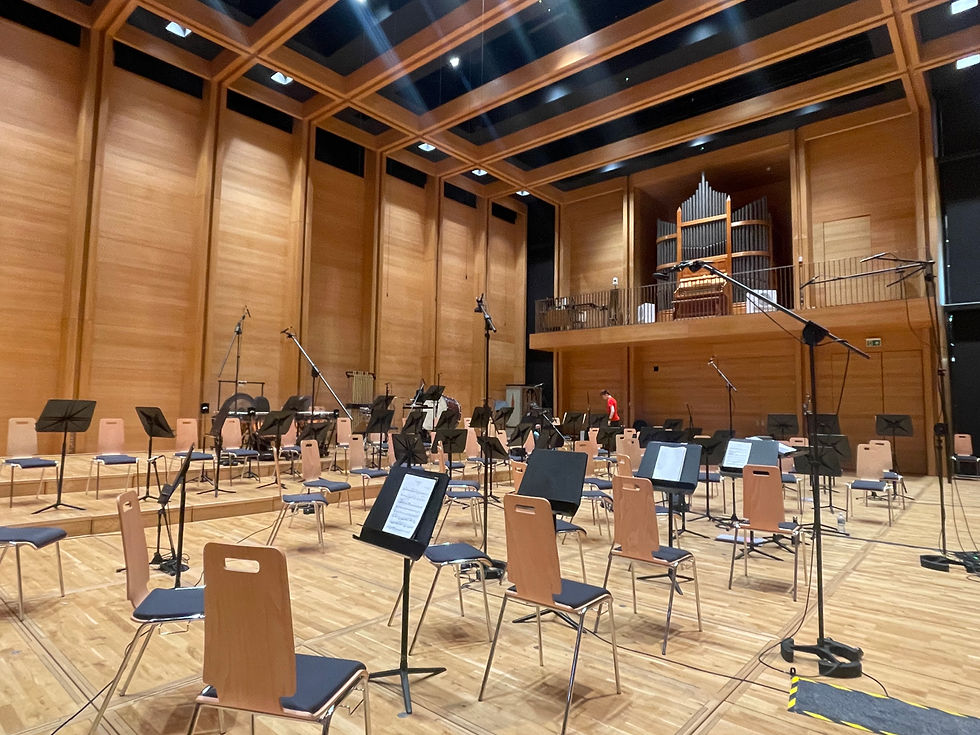
Our team arrived on Sunday evening to prepare the McPherson Recital Room for the session which would start the following morning. The orchestra seating was already in place with music stands being positioned. Setting up our audio equipment took around two and a half hours, demanding careful attention and teamwork. The McPherson Recital Room has a unique adjustable fully mechanised floor, meaning that 2x1m timber clad panels can be moved at the touch of a button to suit each individual purpose or performance. In this instance, as there was no audience present, the focus would be entirely on the orchestra and a platform was created at the back of the hall for the rear sections. This way there was a clear line of sight between the back of the orchestra and the conductor. Graeme, the centre’s Onsite Technician and Operations Coordinator, was on hand to make these adjustments ahead of microphone placement and cabling.
Bob Whitney was provided a list of microphones from our collection at Fife College and the choice was up to him. He was given this in advance and his choices were deliberate and undoubtably straightforward with his years of experience recording in such renowned studios as Abbey Road. Meeting Bob for the first time, I was struck by his calm and reserved manner; he spoke of his feeling of awkwardness giving us instructions for mic placements and adjustments he wanted to make and I found this endearing and sweet. Of course, we were there under his guidance and looking for direction, and so I reassured him that we were all ears and here to learn. As we began placing microphones on the stands dotted in and around the orchestra and started to run cables from the mics to the Allen & Heath, things started to take shape quickly. The orchestra seating was changed a little to become more compact around the conductor’s podium and the percussion section and their instruments were moved from the right of the hall to the back so that they were the only section on the raised platform. Based on his previous experience with similar spaces, he said this this decision would allow the percussion to be more balanced in the recording.
As I now had a handful of live productions under my belt with Fife College, I’ve become adept at setting up various microphones in orchestras. A majority of the mics that Bob had selected were familiar to me, including DPA 4006, Schoeps cardioid, AKG 414, Audio Technica AT4050, Oktava MK012, Neumann KM 183 and KM184, Coles 4038 and Neumann U87. Additionally, I was comfortable setting up stands, space bars, DECCA tree and have been able to practice a lot of cable running, management and coiling. As utilising a Dante Network, Stage Boxes and MTRX location rig has been well rehearsed during St Andrews Lunchtime Concerts in this venue, I felt fairly confident around the basics here too. Our control room was set up close to the action at Bob’s request, and our cabling was run from the recital room microphones to a stage box, which fed signals through an access hatch in the wall. From there, inputs were routed into our MTRX rig in our makeshift studio next door to the orchestra.
The People Behind the Project
On Monday, the first day of the recording, I met Alan Munro, who described his initial motivation for the project as “paying his dues for being a less-than-stellar student”. He was clearly passionate about the works having read the archived scores from start to finish and creating a Crowdfunder. Though the orchestra had been rehearsing for the recording, Alan had yet to hear the pieces aloud and his eager anticipation was clear to see. I had an overwhelming feeling that he knew something we didn’t and it felt like he had a secret he was ready to tell.
Bede Williams, Deputy Director of Music at the University of St Andrews, was approached about the project and was the main driving force to help Alan achieve his vision. It was Bede who contacted Bob Whitney about the recording as the two had worked together historically. Bob's employment history is nothing short of awe-inspiring, having cut his teeth at EMI before moving to Abbey Road for 9 years and latterly, Sony. He has worked with some of the biggest names in classical music and had admirably come out of retirement to help Bede with this project. With this collaboration brought quality and experience to the project and once the funding was in place, the wheels were in motion.

The Bob Whitney Effect
Bob’s calm, reserved and measured demeanour set the tone for the project. As the orchestra began to play, he was quick to adjust levels and panning, clearly a well-rehearsed procedure before any of his recordings. Unlike live concert recordings, the process involved carving out sections of the score at a time, for example Bede would take the orchestra from part A to C before turning to Bob and asking for his feedback. From the very start, it was clear to see Bob’s acute sense of tempo as picked out what parts of the orchestra were speeding up where, or what section was playing too slow for what the score dictated. His attention to tuning issues was also incredibly impressive; these tuning issues were miniscule to an untrained ear and seemed only apparent to Bob, until they were soloed out in the orchestra under Bede’s instruction and adjustments were made. To communicate with the orchestra and with Bede, Bob was given a handheld mic which was connected to the PA speakers in the recital room. It wasn’t long into the afternoon that Bede jokingly pointed out that this way of talking to them gave the effect of a “voice of God”, which felt entirely appropriate on so many levels!
As the recording continued, Bob monitored the score very closely, as though reading a book, reading and interpreting multiple parts of the orchestra at once, on the spot, with no prior preparation. His decades of experience was clear to see as he was able to interpret the score note for note without embellishments or interpretations and relay this to the orchestra if they even slightly veered away creatively. He seemed to know when to push for another take and when the orchestra had been pushed enough to move on. This alone is quite remarkable to me, since he has never worked with this orchestra before but seemed to have a grasp on their limitations and capabilities all at once. I found out later that day that Bob was a tuba player in the past, and as a fellow brass player this explained his concern and consideration for physically taxing parts in the score. In understanding this for all areas of the orchestra, he knew how to best manage and approach individuals or groups to get a perfect take.
To my surprise and fascination, the recording element only played a small role and Bob’s interaction with Pro Tools was minimal; other than start/stop recording and adding numbered markers to line up with his numbers on the score, there was little to be done other than listen and read. According to Bob, any plugins or effects was minimal both during the record and in post-production. He noted Sonnox Oxford EQ and iZotope RX series as two of his go-to tools in post-production, so I made a note to look into these ahead of my next mixing project.

Spare Part
During the first afternoon of recording as the orchestra played towards the end of a piece, Bede looked puzzled and questioned the percussion section. They established that there weren’t enough percussionists present to cover all the four instruments playing in the score. The piece in question was coming to a close and demanded multiple percussive instruments to reach the “grand finale”. The three percussionists were occupied between the timps, snare and bass drum but the cymbal part was left out and to Bede this sounded wrong. Bede took a pause to consider his options and came to the sound team “behind the curtain” to ask if anyone could step in.
While being on this course I have made a personal promise to myself that I would say “yes” to everything, ensuring that I take advantage of all opportunities that might come my way. As I’ve been doing so far, I volunteered without any hesitation. I can read music well and it was a simple cymbal part from what I could see, so how hard could it be? As I made my way to the percussion section at the back of the hall, the orchestra applauded and whooped, and nerves began to form. Although I had played in high school orchestras, a 25-year hiatus felt, as it should, like a quarter of a century ago. After a couple of tries, all hopes riding on the orchestra pausing and playing one euphoric note in unison, we finally managed to get two takes that Bob was happy with. We all took a break and I laughed away my nerves to the support of the percussionists around me.
It turned out to be the first of three appearances in percussion during the recording. I don’t think I’ll be touring the world anytime soon, but I suppose my role as a spare part was good enough to make the cut on the day!

"There's a fish in the water..."
One of the main challenges was maintaining consistent tuning throughout the sessions. Bob’s well-tuned ear caught any discrepancies, with the orchestra responding quickly to his guidance over the PA. Bede had noticed this incredible skill and I could tell he was impressed by Bob’s abilities. On the second day of recording, Bede said to the orchestra "Every time we go fishing, there's a fish in the water and we get it out!" I just loved this statement, and it sums up Bob's expertise to a tee! The pair worked really well together and their relationship stretches back 23 years; they seemed to quite effortlessly get the best out of the orchestra, and it was clear from their calm and understanding approach that they had a good working relationship. This attention to detail that would set the recording apart and ensure that the result would be of the highest quality possible.
What Bob could do was utterly awe-inspiring, and I was astonished to learn that he needed no preparation reading the score before the recording started. Prepared for a complex answer, I asked him what his secret was. “Practice. Lots of practice. It’s a simple as that.”

The Importance of Legacy Recordings
Cedric Thorpe Davie’s compositions, some of which were written for films, had been stored away and untouched for decades. Without collaborative efforts like this, much of his work might not have come to light and would remain unheard. Recordings of this nature require more than just funding; they demand respect for the music itself and in this case, its meaning to Alan, the man behind the project. Alan said he could tell the compositions were impressive when he found them, but he wasn't prepared for quite how moving and dramatic they were as they played out in real life. It was an emotional experience for him and at numerous moments over the course of the three days, I nudged him and smiled as he welled up in the seat next to me. This project had been three years in the making and to have Thorpe Davie’s music played so well and for it to be treated with such courtesy and respect, it was hard not to be moved too.

Final Thoughts on the Legacy Recording
The Cedric Thorpe Davie legacy recording at Laidlaw Music Centre was much more than a technical exercise. It was a meaningful project that connected the people involved through some quite incredible music. Watching Bob Whitney work and having the privilege of assisting him provided a firsthand look at the skill involved and the importance of careful and considerate collaboration and I can't wait to hear the final product later this year.

Bede Williams and I


Comments